Tuesday, October 22, 2013

Tuesday, October 8, 2013
WEEK 14
1. Difference Between Corporate Level Strategy and Business Unit Level Strategy
Corporate Level Strategy: It refers to the overall
strategy that affects the firm as a whole. Making decisions on highest level
falls under this strategy that have an affect on several business units. It
helps to decide which markets to compete in and where, geographically, to
operate.
Business Unit Level Strategy: It is a low level
strategy that competes in a particular sector. It is mainly deals with gaining
a competitive advantage in the market.
Corporate level strategy
|
Business Unit Level Strategy
|
Focuses mainly on the issues that affect the firm
as a whole
|
Focuses mainly on specific business unit
|
It is developed by board of directors
|
Formed by individual mid-level managers
|
It is long-term strategy and cannot be changed
frequently
|
It can be changed regularly in order to respond to
changes in the markets
|
Strategic issues include financial structure of the
firm, mergers and acquisitions, and allocation of resources
|
Its strategic issues include the pricing and
marketing strategies
|
2. Discuss the parenting style of Virgin group

Virgin group is a British multinational branded
venture capital conglomerate company. The core business areas of the company
are travel, entertainment and lifestyle and it has more than 400 companies
worldwide.
Virgin believes in making a difference and believes
that they are different from rest. The model of the organization is to develop
each business separately with its own shareholders and management. Since the
company comprises of large collection of businesses, it has low parental
control over them. It has various strategic business units (SBU). “Companies
within the Virgin group are part of a family rather that a hierarchy”, the SBUs
in the virgin group are separate and independent. The decision-making is decentralized;
each SBU is empowered to run their own affairs, yet another companies help one
another. This states that it focuses on each business unit responsiveness to
the centrally locates capital and monitors. The parent company mainly acts as a
parental developer.
The success of the company is based on the corporate
parenting strategy, i.e., every new business unit inherits company’s brand
name, values, management styles, support and access to resources not expending
resources to create them. (examiner.com,
2013)
Richard Branson said in 2005, “ Our model is to
develop each business separately with its own shareholder and management. In
this way we can concentration the job in hand, rather than be a part of some
enormous and faceless conglomerate.”
As McQuade said in his research “Virgin group has
been described as a ‘keirestu’ organization-a structure of loosely linked
autonomous units run by a self managed tams that use a common name.”
References:
Virgin Group. Virgin Corporate History. [Online] Available at: http://www.virgin.com [Accessed on
8 Oct, 2013]
A Company Profile: Virgin [Online] Available at: http://www.examiner.com/article/a-company-profile-virgin,
[Accessed on 8 Oct, 2013]
Tuesday, May 28, 2013
WEEK 11
GROUP VIDEO ON NESTLE.
http://www.youtube.com/watch?v=CIHqanDmhiY
Group members:
Amrita Gurung
Ashmita Gurung
Dhurba Godhar
Sandup Tsering Sherpa
Sunita Gugung
Strategic Analysis done:
PESTLE Analysis
Porters's Five Forces model
Value Chain Analysis
SWOT Analysis
Strategic grouping
http://www.youtube.com/watch?v=CIHqanDmhiY
Group members:
Amrita Gurung
Ashmita Gurung
Dhurba Godhar
Sandup Tsering Sherpa
Sunita Gugung
Strategic Analysis done:
PESTLE Analysis
Porters's Five Forces model
Value Chain Analysis
SWOT Analysis
Strategic grouping
Wednesday, May 1, 2013
WEEK 10
1) In your own words and using referenced quotes describe what is meant in strategy by 'Organisational Purpose‘ and describe what is meant by 'Corporate Social Responsibility‘.
Organizational Purpose:
Organizational purpose defines the fundamental reason for the organization's existence. It acts as a guiding force upon which every other decision is rooted. It dictates how you will use your time, attention, and resources to serve your niched market better than anyone else. It is important for any business because:
2.Should organisations focus more on profit and shareholder satisfaction or responsibility and stakeholder satisfaction? Discuss your own thoughts but try to support your ideas with theory or examples.
Profitability and responsibility can be combined in an ideal world, where business can make as much profit as possible along with meeting all its responsibilities, keeping its shareholders and stakeholders happy. However, it is clear that it is least partially contradictory. On one hand, business must be profitable to survive and must earn a higher return on the shareholders equity. While on the other hand, companies are a network of parties and people working together towards a shared goals.
In my opinion, companies should take a step towards CSR. The ultimate aim or mission of the company is to earn profit. In order to do that company must first take responsibilities towards its customers, suppliers and employees. If they are able to fulfill their needs, then only they can work effectively to achieve its aim leading to profit maximization.
Much evidence shows that social responsibility, including business ethics, is associated with increased profits. For example, one survey indicates that three out of four consumers refuse to buy from certain businesses, and a business's conduct was considered an important reason to avoid a business. An important academic study found a direct relationship between social responsibility and profitability. The study also found that social responsibility contributes to employee commitment and customer loyalty- vital concern for any firms trying to increase profits.
3) Write about your experience with today's case study. What answers did you give to the questions? What did you think of the CEO?
Today's case was very interesting. It talked about how Pepsico focused on Organizations purpose and Corporate Social responsibilty that are incorporated in their strategies.
References:
Enterprise and Industry, Corporate Social Responsibility [Online] Available at http://ec.europa.eu/enterprise/policies/sustainable-business/corporate-social-responsibility/index_en.htm [Accessed on 1 May 2013]
Corporate Social Responsibility. [Online] Available at: http://www.untag-smd.ac.id/files/Perpustakaan_Digital_1/CORPORATE%20SOCIAL%20RESPONSIBILITY%20The%20Debate%20Over%20Corporate%20Social%20Responsibility.pdf [Accessed on 1st May 2013]
Organizational Purpose:
Organizational purpose defines the fundamental reason for the organization's existence. It acts as a guiding force upon which every other decision is rooted. It dictates how you will use your time, attention, and resources to serve your niched market better than anyone else. It is important for any business because:
- It energizes the company to move forward
- It empowers the passion
- It frees resources
- It separates from the pack
- It helps them to maintain a strategic outlook on their competitors
- It helps to find a way to view the competition as a potential value-added partner
- It helps to focus on their actual greatest threat
- It helps to continuously evolve
Corporate Social Responsibility:
CSR is defined as a business outlook that acknowledges responsibilities to stakeholders, suppliers, customers, and employees as well as local and international communities in which it operates and the natural environment.
Corporate social responsibility is also referred to as "corporate citizenship" and involve incurring short
term costs that do not provide an immediate financial benefit to the company, but instead promote positive social and environmental change.
2.Should organisations focus more on profit and shareholder satisfaction or responsibility and stakeholder satisfaction? Discuss your own thoughts but try to support your ideas with theory or examples.
Profitability and responsibility can be combined in an ideal world, where business can make as much profit as possible along with meeting all its responsibilities, keeping its shareholders and stakeholders happy. However, it is clear that it is least partially contradictory. On one hand, business must be profitable to survive and must earn a higher return on the shareholders equity. While on the other hand, companies are a network of parties and people working together towards a shared goals.
In my opinion, companies should take a step towards CSR. The ultimate aim or mission of the company is to earn profit. In order to do that company must first take responsibilities towards its customers, suppliers and employees. If they are able to fulfill their needs, then only they can work effectively to achieve its aim leading to profit maximization.
Much evidence shows that social responsibility, including business ethics, is associated with increased profits. For example, one survey indicates that three out of four consumers refuse to buy from certain businesses, and a business's conduct was considered an important reason to avoid a business. An important academic study found a direct relationship between social responsibility and profitability. The study also found that social responsibility contributes to employee commitment and customer loyalty- vital concern for any firms trying to increase profits.
3) Write about your experience with today's case study. What answers did you give to the questions? What did you think of the CEO?
Today's case was very interesting. It talked about how Pepsico focused on Organizations purpose and Corporate Social responsibilty that are incorporated in their strategies.
The strenghts and benefits of this kind of strategies are;
- improved financial performance
- enhanced brand image and reputation
- increased sales and customer loyality
- increased ability to attract and retain customers
- easier access to capital
- comply with regulatory environment
The weakness and disadvantage of this strategy:
- it is an expense to the company, the main reasons any company would object to participating in CSR is the associated costs.
- shareholder expectation: when considereing CSR is the possible negative perception of shareholders.
- loss of focus.
Enterprise and Industry, Corporate Social Responsibility [Online] Available at http://ec.europa.eu/enterprise/policies/sustainable-business/corporate-social-responsibility/index_en.htm [Accessed on 1 May 2013]
Corporate Social Responsibility. [Online] Available at: http://www.untag-smd.ac.id/files/Perpustakaan_Digital_1/CORPORATE%20SOCIAL%20RESPONSIBILITY%20The%20Debate%20Over%20Corporate%20Social%20Responsibility.pdf [Accessed on 1st May 2013]
Monday, April 29, 2013
WEEK 9
1) In your own words and using referenced quotes describe what is meant in strategy by the 'Resource-Based View'?
ØResource-Based View (RBV):
It is a way of viewing the firm and in turn of approaching strategy. This theory formulates the firm to be a bundle of resources. It is these resources and the way they are combined, which make firms different from one another. it is considered as taking an inside-out approach while analysing the firm. The RBV is based on the idea that effective and efficient application of all usable resources that the company can muster shows its competitive advantage. This means the starting point of the analysis is the internal environment of the organization.(etheses.nottingham.ac.uk,2013)
2)How might you undertake 'Internal Strategic Analysis' ? What models would you apply and why/ Where would you go to find the information you need?
ØInternal Strategic Analysis is very important for an organization as it focuses on strengths and weakness of the internal factors that give them certain advantage and disadvantages in meeting the needs of its target market.
There are different methods to access the internal analysis of an oragnization, which are :
References:
[online] Available at: http://etheses.nottingham.ac.uk/3271/1/442284.pdf [Accessed on 29th April 2013]
ØResource-Based View (RBV):
It is a way of viewing the firm and in turn of approaching strategy. This theory formulates the firm to be a bundle of resources. It is these resources and the way they are combined, which make firms different from one another. it is considered as taking an inside-out approach while analysing the firm. The RBV is based on the idea that effective and efficient application of all usable resources that the company can muster shows its competitive advantage. This means the starting point of the analysis is the internal environment of the organization.(etheses.nottingham.ac.uk,2013)
2)How might you undertake 'Internal Strategic Analysis' ? What models would you apply and why/ Where would you go to find the information you need?
ØInternal Strategic Analysis is very important for an organization as it focuses on strengths and weakness of the internal factors that give them certain advantage and disadvantages in meeting the needs of its target market.
There are different methods to access the internal analysis of an oragnization, which are :
- Resource-Based View
- Value Chain Analysis
- SWOT Analysis
- TOWS Analysis
- McKinsey 7 S model, etc
If I were to analyse the internal environment of a company, I would choose SWOT analysis because it is both simple and powerful for strategy development. It is easy to use, cost less and consumes very less time to complete. It is a useful technique for understanding strengths and weakness, and for identifying opportunities and threats that the company faces. Strengths refer to the core competencies that give firm an advantage whereas weakness refers to limitation the company faces in developing or implementing strategy. Ii also identifies the area of 'need' in which company can perform profitably. It helps to support mission, vision and objectives that has been already defined. It provides perspective and will reveal connections and areas of action.
3) Talk about your group video work. How is it going so far ? do you have a plan? What are you most worried about at the moment ? what is going well?
ØSo, far we have done all the research that needs to be done. Everyone in the group has done their share of research. It is getting difficult to incorporate all those information into one project. At the moment I am most worried about finishing the work and get desired output ready on time. The one thing that is going well is that we have a good teamwork and everyone is working together as a team. Everyone is determined and working hard together to achieve the goal.
3) Talk about your group video work. How is it going so far ? do you have a plan? What are you most worried about at the moment ? what is going well?
ØSo, far we have done all the research that needs to be done. Everyone in the group has done their share of research. It is getting difficult to incorporate all those information into one project. At the moment I am most worried about finishing the work and get desired output ready on time. The one thing that is going well is that we have a good teamwork and everyone is working together as a team. Everyone is determined and working hard together to achieve the goal.
References:
[online] Available at: http://etheses.nottingham.ac.uk/3271/1/442284.pdf [Accessed on 29th April 2013]
WEEK 8
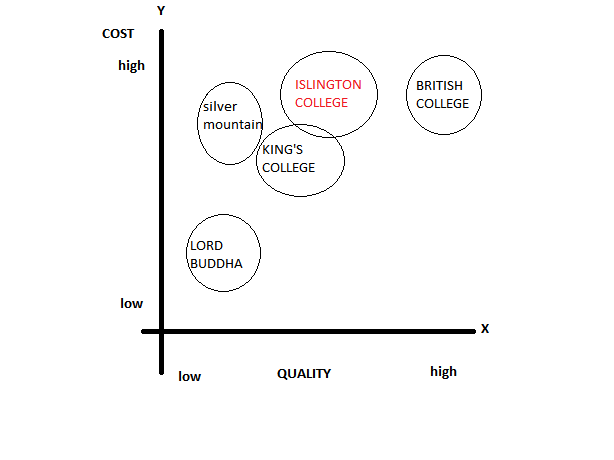
1. Complete your strategic grouping diagram for Islington college (task 3 - slide 48) and post it on your learning journal
Islington College is an educational institution that provide bachelors degree for business and information technology (IT). It is one of the well known college in the country. It is directly affiliated with the London Metropolitan University, UK.
Islington College is an educational institution that provide bachelors degree for business and information technology (IT). It is one of the well known college in the country. It is directly affiliated with the London Metropolitan University, UK.
The list of competitors of Islington College are:
- The British College
- Silver Mountain College
- St.Xavier's College
- APEX College
- Kathmandu University- college of engineering
- Lincoln College
- Deerwalk Institute of Technology
- King's College
Porter's 5 Forces Model for Islington College:

Strategy Grouping Of Islington College:
Sunday, April 7, 2013
WEEK 7
External Analysis:
The External Analysis examines opportunities and threats that exist in the environment. both opportunities and threats exist independently of the firm.
It is a method of reviewing the macro environment (external forces that impact a company's ability to plan). It stands for:
- Political
- Economic
- Sociological
- Technological
- Legal
- Environment
It looks at the external business environment and is an appropriate strategic tool for understanding the "big picture" of the environment in which the business operates, enabling it to take advantage of the opportunities and minimize the threats faces by its business activities.
A PESTLE analysis enables the company to take long-term perspective, and clarify strategic opportunities and threats that it faces. (www.coursework4you.co.uk, 2013)
PESTLE Analysis of BIG MART SUPERMARKET:

Political Factor:
- influenced by political and legislative condition of the country
- employment legislation, the government encourages retailers to provide a mix of job opportunities from flexible, lower-paid and locally based jobs to highly-skilled, higher-paid and centrally -located jobs.
- unstable political situations could create problems regarding the law and policies of the country for the mart to successfully carry their activity.
Economical Factors:
- likely to influence demand, costs, prices and profits
- increase inflation and unemployment rate may decrease effective demand for goods, adversely affecting the demand for producing the goods
- increase in the living standard of Kathmandu may increase potential buyers
Social Factors:
- customers more interested in 'one stop' and 'bulk' shopping due to various social changes
- customer are becoming more health conscious than before, so strategy of the supermarket must also change by increasing the stock of organic products.
- customer satisfaction can be driven by customer care by being helpful and also providing various services as discount to members, and adding schemes on various occasion that benefit the customer.
Technological factors:
- new technological benefits both customer and company because shopping becomes more convenient, goods can be readily available and services can be personalized
- BIG MART is keeping up with the technology as it has different LCD screens, CCtv all over the places and also has a credit card payment system.
Legislative Factors:
- Established powerful competitor such as Bhat-Bhateni may create a threat of intense price war and strong requirement for product differentiation
- It mostly gives importance to the imported products that are high in number which may increase tax and hence increase in the price of the good
Environmental Factors:
- the store must take steps to become eco friendly
- they must take steps in managing the usage of plastic and also managing the waste
- provide the people a message and spread knowledge about environmental issues by funding or joining different campaign.
3) For the research, we made a group of five members and went to BIG MART for a quick visit. We closely observed the market and also had some talk with the employees. After discussing about the research we had done so far, we came t o a conclusion and did our PESTLE research.
Reference:
E-Kantipur, 2012. eKantipur.com. [Online] Available at: http://www.ekantipur.com/2012/08/01/business/big-mart-to-open-seven-stores-in-kathmandu-by-2012/358057 [Accessed on 7 April 2013].
What is pestle analysis. [Online] Available at: http://www.coursework4you.co.uk/essays-and-dissertations/pest-analysis.php [Accessed on 7 April 2013]
Reference:
E-Kantipur, 2012. eKantipur.com. [Online] Available at: http://www.ekantipur.com/2012/08/01/business/big-mart-to-open-seven-stores-in-kathmandu-by-2012/358057 [Accessed on 7 April 2013].
What is pestle analysis. [Online] Available at: http://www.coursework4you.co.uk/essays-and-dissertations/pest-analysis.php [Accessed on 7 April 2013]
Big Mart, [Online] Available at http://www.bigmart.com.np/ [Accessed on 7April 2013]
Subscribe to:
Posts (Atom)